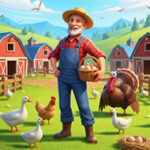
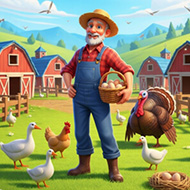
What actually happens if you skip refilling the water trough for a full day in Eggstreme Farming? The birds don’t just look thirsty and reset — their health and egg output start sliding, and that one consequence sums up the whole point of the game. Eggstreme Farming puts you in charge of a first-person poultry operation that starts with a handful of birds and a couple of pens, then asks you to keep every animal fed, watered, and productive while you turn a backyard coop into something closer to a business.
| Genre |
Casual, Simulation, Farm Management |
| Perspective |
First-person |
| Player Mode |
Single-player |
| Animal Species |
Chickens, ducks, geese, turkeys |
| Core Loop |
Feed, collect, sell, expand |
| Progression System |
XP from daily tasks, unlocked via licenses |
What Eggstreme Farming Actually Puts You In Charge Of
New animals don’t just appear in a pen ready to go. You unpack delivery boxes and sort each bird into the pen built for its species, because chickens, ducks, geese, and turkeys are treated as separate operations rather than reskins of the same animal. That sorting step matters more than it looks — put a species in the wrong setup and the care routine stops matching what the pen offers.
Once the birds are settled, the job becomes upkeep. Food and water containers run down and need regular refilling, and the game lets you choose between feeds of different quality, which affects how healthy the birds stay and how much they produce. Sick or neglected animals need medicine or vaccines, so the health system carries real consequences.
All of this runs on a day-and-night cycle that paces out how much you can realistically get done before the farm goes dark. Players who enjoy slower, chore-based management sims tend to describe this rhythm as the part that hooks them.
Chickens, Ducks, Geese, and Turkeys Don’t Run on the Same Clock
Each species in Eggstreme Farming is built around its own needs rather than a shared stat block, meaning geese and turkeys don’t behave like a chicken with a different skin. That’s a deliberate design choice, and it turns into four small routines instead of one big one.
A lot of early friction comes from treating every pen the same way out of habit. A setup that keeps chickens happy won’t automatically do the same for ducks, and the game expects you to notice the difference rather than explaining it outright.
Furniture, shelves, and plants are available for organizing pens beyond the bare minimum, which matters to players who like their farms tidy as much as they like the income going up.
Trays, the Vending Machine, and the Shape of a Working Day
Eggs get gathered by hand into trays rather than vanishing into an inventory number, and once a tray is full, the vending machine is where it turns into money. That collect-then-sell loop is the backbone of every session, repeated enough times per day that the small chores start to feel like a checklist.
- Refilling food and water containers before they run empty
- Checking pens for sick birds and applying medicine or vaccines
- Collecting fresh eggs into trays as nests fill up
- Selling completed trays at the vending machine for income
- Reinvesting profits into new animals, pens, or store supplies
Running a bigger operation also means running a bigger bill. The game tracks ongoing utility costs — water, electricity, even internet — once you start renting additional pens, so expansion becomes a recurring expense rather than a one-time purchase. That detail tends to surprise players expecting a simpler farm-and-sell loop.
Licenses, XP, and Where the Demo Currently Stops
Progress comes from XP, earned by finishing the same daily tasks that keep the farm running: collecting eggs, selling trays, and looking after animals. Leveling up unlocks new licenses, which is the game’s way of gating expansion — you can’t buy into a bigger farm without proving you can manage the smaller one.
The version most players have access to now is a demo, explicitly scaled down: four species and two pens, two tiers of feed, and four pieces of furniture or equipment, with automation held back for the full release. Demo save data doesn’t carry over, so anything built there is a preview rather than a head start.
Early reception has been mixed rather than glowing — a small pool of user reviews split close to evenly between positive and negative, with some players raising technical optimization concerns. The developers have acknowledged this feedback and framed the demo period as an ongoing process of fixing those issues before the full farm opens up.
Common Questions About Eggstreme Farming
- Is Eggstreme Farming single-player or does it support multiplayer? It’s built as a single-player experience — there’s no co-op or shared-farm mode, just one player managing the pens, trays, and licenses at their own pace.
- What’s different between the demo and the full version of Eggstreme Farming? The demo limits you to four species, two pens, two feed types, and four furniture or equipment items, and locks out the automation systems planned for the finished game.
- Do chickens, ducks, geese, and turkeys need different care? Yes — each species has its own needs and its own dedicated pen, so a routine that works for one won’t automatically keep the others productive.
Eggstreme Farming isn’t trying to dress up its chore list as something else — the loop of refilling troughs, sorting new arrivals, and sliding full trays across the vending machine counter is the whole appeal, and the license system makes sure you earn the bigger pens instead of skipping to them.